

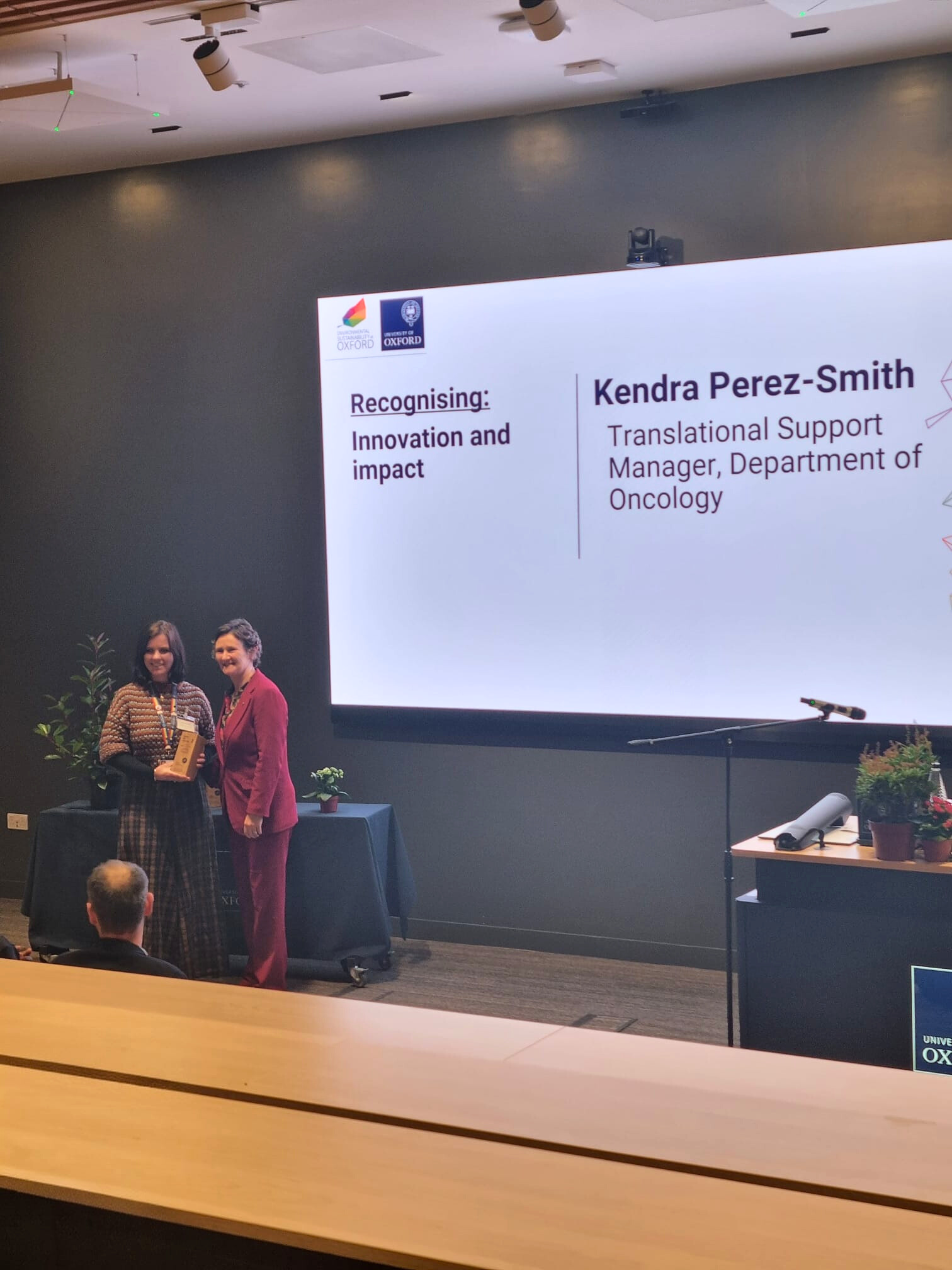
The Department of Oncology is proud to share that Kendra Perez-Smith, Translational Support Unit (TSU) Manager, has received an Outstanding Contribution to Sustainability Award in recognition of her innovation and leadership in establishing Lab QuTe: a department-wide network designed to reduce the environmental impact of clinical trials.
Kendra was presented with the award by Vice-Chancellor Professor Irene Tracey at the LEAF Oxford Forum 2025, a flagship event celebrating sustainability achievements across the University. The forum showcased how Oxford scientists are leading the way in embedding sustainable practices into research and operations.
The Lab QuTe (Laboratory Quality and Technical) Network was inspired by the need to address challenges faced by labs working in isolation. Kendra recognised that independent working often leads to missed opportunities for collaboration, resource optimisation, and sustainable practice. In response, she created a department-wide network that brings together laboratory professionals to promote collaboration and resource sharing, while encouraging sustainable working practices and supporting professional development.
Kendra leads the Translational Support Unit, a dedicated unit within the Oncology Clinical Trials Office (OCTO) that focuses on the operational and scientific side of biological sample management in clinical trials. Her team specialises in making sure every biological sample from every participant is handled, processed, and stored under the highest quality and regulatory standards.
Clinical trials can be resource-intensive due to strict regulatory requirements and thus, can generate significant waste. Recognising this challenge, Kendra identified an opportunity to reduce environmental impact without compromising scientific integrity. Under her leadership, Lab QuTe has introduced practical solutions that are already delivering measurable benefits.
Environmental sustainability:
Lab QuTe has developed practical methods for the repurposing and sharing of equipment and consumables from surplus or expired clinical trial kits. Usable items such as pipettes, conical tubes, and cryovials are salvaged and redistributed to labs in need rather than being disposed of. This approach reduces waste, lowers procurement costs, and conserves valuable resources.
Empowering laboratory professionals:
Lab QuTe fosters a community where laboratory professionals can connect, share, and learn from each other, aiming to create a sustainable and empowered network that supports professional growth. This includes peer-to-peer training, where technicians teach colleagues from other labs specialised techniques such as equipment maintenance and peripheral blood mononuclear cell (PBMC) processing.
Quality assurance and accreditation
The network also supports quality assurance by providing peer-to-peer advice on accrediting bodies and the systems required to meet accreditation standards.
The success of Lab QuTe contributed to the TSU achieving a Gold LEAF Award in 2024 and 2025.
Meeting a clear need within the research community, Lab QuTe is bringing together technical staff who often work behind the scenes and championing sustainable working. By integrating sustainability, collaboration and professional development into laboratory practice, Lab QuTe stands as a powerful example of how collective action can support high-quality research while drive meaningful environmental improvements.